
Contributors:
Tania Sanai Shimabukuro, Feiyang Wang, Mariana Shimabukuro, Christopher Collins
Abstract
Exploring scatterplots is harder than it looks. Dense, overlapping data points make it easy to lose track of what you’re searching for — and every click, zoom, or tooltip delay adds up. What if the chart could quietly adapt to what you’re already looking at?
Four Techniques, Zero Commands
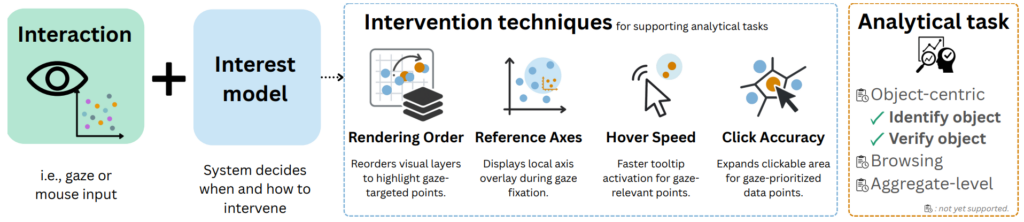
Using an eye tracker, the system continuously infers which data points a user is attending to. The moment interest is detected; one of four gaze-aware techniques activates silently in the background:
Rendering Order: Brings your points of interest to the front, reducing visual clutter without changing the data.
Reference Axes: Displays a local axis overlay near your gaze region, so you can read exact values without scanning to the edges.
Hover Speed: Reduces the tooltip delay for points you’re already looking at — information arrives faster, right when you need it.
Click Accuracy: Expands the clickable area around your points of interest, making selection more forgiving in crowded regions.
Key Findings
In a study with 24 participants, gaze-aware adaptations improved task efficiency and reduced cognitive load. Hover Speed was the clear favourite — cutting cumulative tooltip wait time by 61% and rated most helpful by users. Having all techniques available at once led to the best overall performance.
What’s Next?
Future work will explore expanding these techniques to other visualization types and analytic tasks, and investigate hybrid models that blend implicit gaze signals with explicit user controls.
Learn More
Read our paper: https://doi.org/10.1145/3797246.3803027
Project Page: https://vialab.github.io/GazeAwareScatterplots/
GitHub: https://github.com/vialab/GazeAwareScatterplots.git
Video Presentation
Publications
-

Shimabukuro, T. S., Wang, F., Shimabukuro, M., & Collins, C. (2026). Designing implicit gaze-aware interactions for scatterplot analysis [Short paper]. In Proceedings of the ACM Symposium on Eye Tracking Research and Applications (ETRA). ACM. https://doi.org/10.1145/3797246.3803027
@inproceedings{shimabukuro2026gaze,
title={Designing Implicit Gaze-Aware Interactions for Scatterplots},
author={Shimabukuro, Tania Sanai and Wang, Feiyang and Shimabukuro, Mariana and Collins, Christopher},
year={2026},
doi = {10.1145/3797246.3803027}
}