
Contributors:
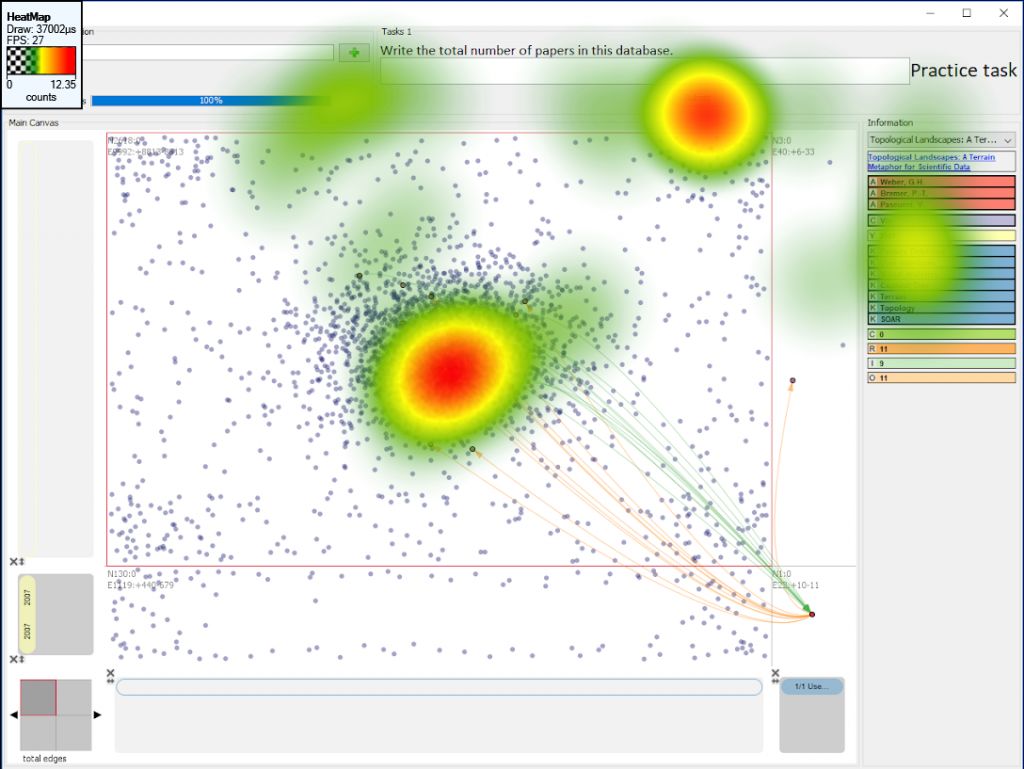
The work describes an efficient model to detect negative mind states caused by visual analytics tasks. We have developed a method for collecting data from multiple sensors, including GSR and eye-tracking, and quickly generating labelled training data for the machine learning model. Using this method we have created a dataset from 28 participants carrying out intentionally difficult visualization tasks. We have concluded the paper by discussing the best performing model, Random Forest, and its future applications for providing just-in-time assistance for visual analytics.
Blog Post
Making Data Less Stressful: A Smart System That Knows When You’re Frustrated
Publications
-

Panwar, P., & Collins, C. (2018). Detecting negative emotion for mixed initiative visual analytics [Poster]. In Extended Abstracts of the SIGCHI Conference on Human Factors in Computing Systems (CHI EA). ACM. https://doi.org/10.1145/3170427.3188664
@poster{pan2018a, author = {Prateek Panwar and Christopher Collins}, title = {Detecting Negative Emotion for Mixed Initiative Visual Analytics}, booktitle = {Proceedings of the SIGCHI Conference on Human Factors in Computing Systems (CHI)}, year = 2018, note = {Late-breaking Work}, doi = {10.1145/3170427.3188664} } -

Panwar, P., Bradley, A., & Collins, C. (2018). Detecting negative emotion for mixed initiative visual analytics. In IEEE VIS Workshop on Machine Learning from User Interaction for Visualization and Analytics (MLUI).
@InProceedings{pan2018b,
author = {Prateek Panwar and Adam Bradley and Christopher Collins},
title = {Detecting Negative Emotion for Mixed Initiative Visual Analytics},
booktitle = {Machine Learning from User Interaction for Visualization and Analytics},
year = 2018
}